
Multi-User Support
Memori provides built-in multi-user and multi-process isolation through its attribution system. Each combination of entity, process, and session creates an isolated memory space — user A never sees user B's memories, and your support bot has different context than your sales bot.
Isolation Model
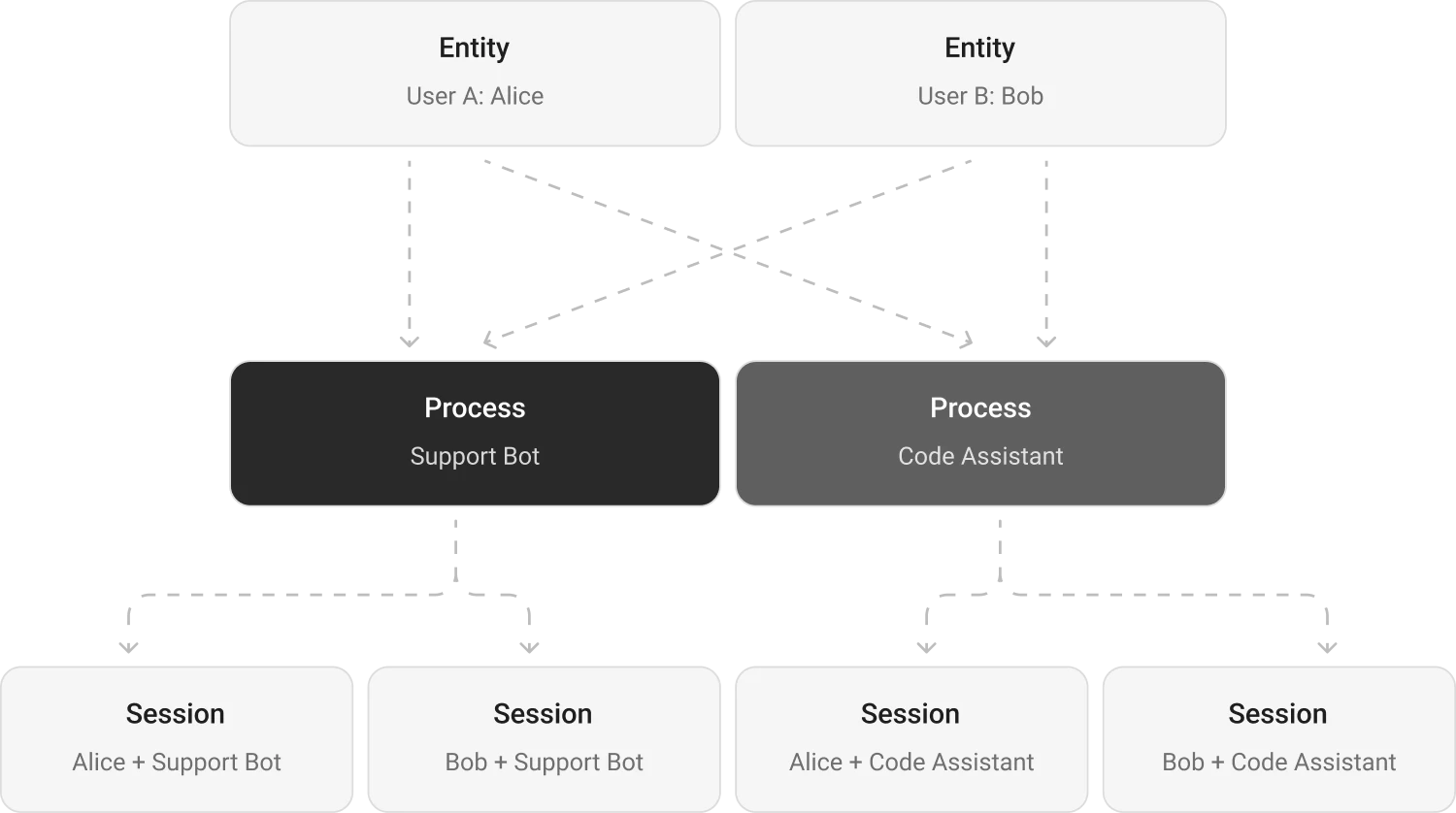
What's Shared vs Isolated
| Data | Scope |
|---|---|
| Facts | Per entity — shared across all processes |
| Preferences | Per entity |
| Skills | Per entity |
| Attributes | Per process |
| Conversations | Per entity + process + session |
| Sessions | Per entity + process (auto-generated UUID) |
| Knowledge Graph | Per entity |
Examples
Multi-User Patterns
from memori import Memori
from openai import OpenAI

client = OpenAI()
mem = Memori().llm.register(client)

# User A's conversations
mem.attribution(entity_id="user_alice", process_id="support_bot")
response = client.chat.completions.create(
    model="gpt-4o-mini",
    messages=[{"role": "user", "content": "I prefer dark mode"}]
)

# User B's conversations — completely isolated
mem.attribution(entity_id="user_bob", process_id="support_bot")
response = client.chat.completions.create(
    model="gpt-4o-mini",
    messages=[{"role": "user", "content": "What are my preferences?"}]
)
# Bob will NOT see Alice's preferences
Common Patterns
Web Application
Set the entity ID from the authenticated user. Works with Flask, FastAPI, Django, or any web framework.
from memori import Memori
from openai import OpenAI

def handle_chat(user_id: str, message: str):
    client = OpenAI()
    mem = Memori().llm.register(client)
    mem.attribution(entity_id=user_id, process_id="web_assistant")

    response = client.chat.completions.create(
        model="gpt-4o-mini",
        messages=[{"role": "user", "content": message}]
    )
    return response.choices[0].message.content
Multi-Agent System
Give each agent a unique process ID. Facts are shared across agents for the same entity, but each agent maintains its own conversation history.
from memori import Memori
from openai import OpenAI

def create_agent(user_id: str, agent_name: str):
    client = OpenAI()
    mem = Memori().llm.register(client)
    mem.attribution(entity_id=user_id, process_id=agent_name)
    return client

# Three agents, one user, shared facts
support = create_agent("user_alice", "support_agent")
sales = create_agent("user_alice", "sales_agent")
onboard = create_agent("user_alice", "onboarding_agent")